
|
| |||||||






 Some Special Lilacs Some Special Lilacs (Photos by Richard Hinchcliff, unless otherwise indicated) |
 |
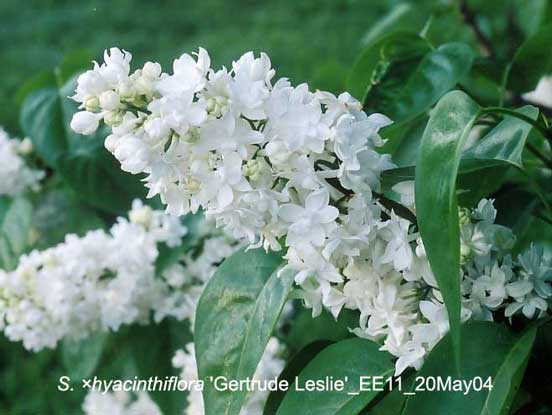
S. �hyacinthiflora 'Gertrude Leslie'; Skinner 1954, Manitoba; D I
Location: EE11 and campus Often the first to bloom at the Farm. A lovely double white, a harbinger of things to come. |
|
|
|
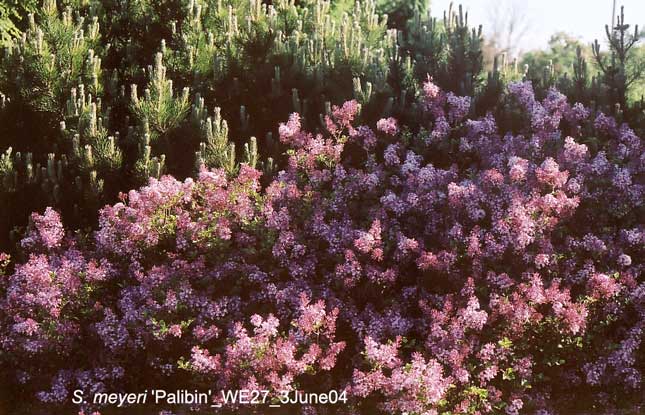
S. meyeri 'Palibin'; pre 1920; S V
Location: WE27 and other Farm areas A very popular small shrub for the garden. This one is 26 years old and very broad, but low, and a mass of bloom. Frequently sold on a standard and two such can be found in Macoun Memorial Garden. |
|
|
|
S. vulgaris 'Sensation'; Eveleens Maarse 1938, The Netherlands; S VII & I
Location: EE31 and Carling Ave. A mutant of 'Hugo de Vries' (a purple) caused by forcing. A true bi-colour, very dramatic and recommended for small gardens. The plant at Carling Ave. has a branch-sport with white flowers, a phenomenon reported by others, elsewhere. |

|
|
|
S. vulgaris 'President Lincoln'; Dunbar 1916, USA; S III
Location: WE20 A lovely blue. Dunbar was creator of the popular Highland Park lilac gardens in Rochester, N.Y. We have 10 more of his originations at the Farm. (Photo by Joan Speirs) |

|
|
|
S. vulgaris 'Aucubaefolia'; Gouchault 1919, France; D III
Location: WW70 and Carling Ave. Variegated leaves make this cultivar unusual. It is a variant of 'Pr�sident Gr�vy', a Lemoine cultivar. |

|
|
|
S.�chinensis; Schmidt ex Willd. (pro sp.); S IV
Location: EE29, EE51, WW45 and Arboretum A beautifully bushy shrub with a mass of bloom and essentially maintenance-free. It did not originate in China as its name suggests but was found in a garden in Rouen, France, about 1780 and was later determined to be a natural cross between S. vulgaris and S. protolaciniata. Equally attractive are cultivars, 'Metensis' S I-IV, WE37, a paler selection, origin not known, ca 1860, and 'Saugeana' S V-VII, EW6, a darker selection originated by Saug� ca 1820, France. |

|
|
|
S. �hyacinthiflora 'Maiden's Blush'; Skinner 1966, Manitoba; S V
Location: EE41 and WW79a Considered one of Skinner's finest, a single, light pink. The shade of pink is known to vary under soil and climatic conditions. |

|
|
|
S. vulgaris 'Ami Schott'; Lemoine 1933, France; D III
Location: WE2 Very double, pink buds open to pink petals which finally turn blue with paler undersides. Just one of many beautiful Lemoine cultivars. |

|
|
|
S. vulgaris 'Krasavitsa Moskvy', (Russian for "Beauty of Moscow"); Kolesnikov 1947, Russia; D I
Location: WE15 and WE74 Considered a rare beauty, one of Kolesnikov's best. Large pink buds open to flowers that are white with a pink tint. Readily available in this area. |
_s1jun03.jpg)
|
|
|
S. vulgaris 'Nadezhda'; Kolesnikov pre 1974, Russia; D III-IV
Location: WW59 The cultivar name is Russian for 'hope'. Another outstanding origination by Kolesnikov who, starting in 1919, used mainly Lemoine hybrids of S. vulgaris for his crosses. Over 60 cultivars were named. His originations are greatly admired world-wide for subtleties in colouration. |

|
|
|
S. pubescens subsp. patula 'Miss Kim'; Meader & Yeager 1954, USA; S II
Location: EW25 and WW18 Most attractive and small in stature. Leaves turn a burgundy-red colour in fall. Blooming begins about June 1st in this area. |
 |
|
|
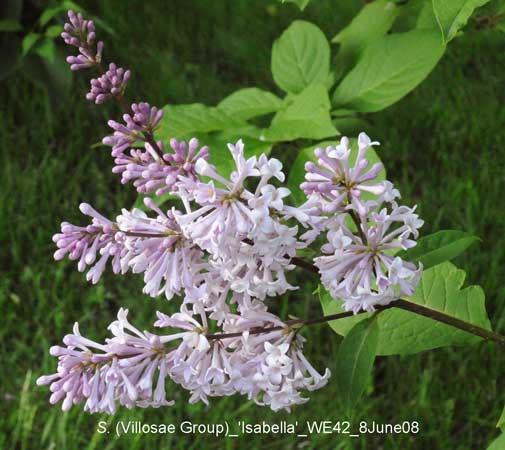
S. �prestoniae 'Isabella'; Preston 1927, CEF Ontario; S IV
Location: WE42, PHC-1-05 and PHC-1-16 A popular late-blooming lilac originated at the Farm by Isabella Preston. It is one of two cultivars selected to represent the nothospecies, S. �prestoniae. 'Isabella' received an Award of Merit from the Royal Horticultural Society, London, England in 1941. It was featured on one of two lilac stamps issued in 2007 by Canada Post. |
|
|
Building 72, Arboretum, Central Experimental Farm, Ottawa, Canada K1A 0C6
Tel: (613) 230-3276 Fax: (613) 230-1238 E-mail: [email protected]